


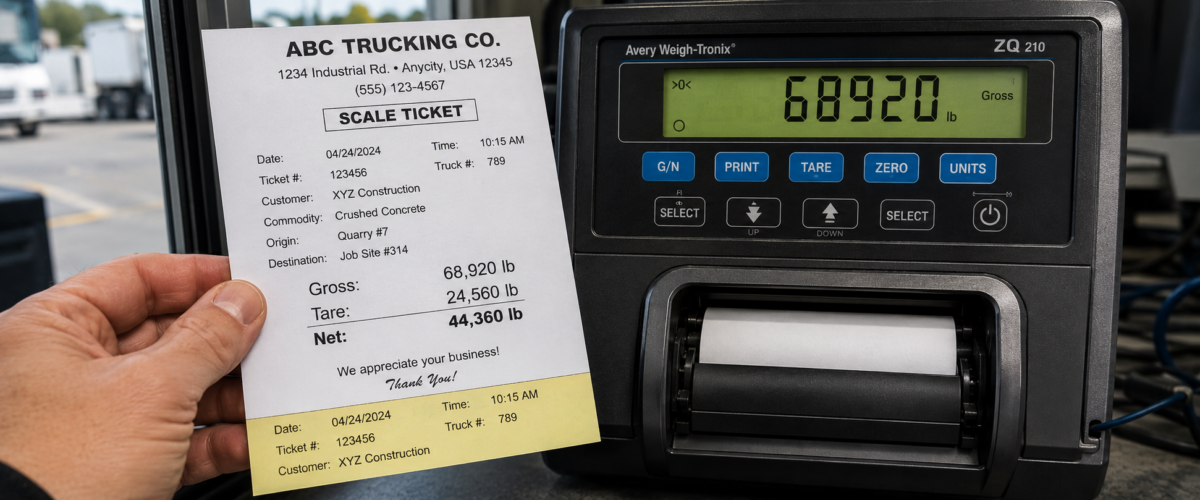
Truck Scale Tickets: What They Record and How to Order the Right Form
Anyone who has worked around a truck scale knows that the weighing itself is only part of the job. The result has to be tied to the right truck, customer, material and transaction. That is the purpose of truck scale tickets.
A good ticket gives the scale operator a quick way to document the load and gives the office a record that can be used for billing, inventory, settlement or customer questions. A poor layout does the opposite: it slows down the scale house, leaves important fields blank and makes old transactions harder to trace.
The best format is not necessarily the one with the most boxes. Instead, it is the one that follows the way trucks actually move through your operation.
What is a truck scale ticket?
A truck scale ticket, sometimes called a weight ticket, weigh ticket or scale form, is the printed record of a vehicle-weighing transaction. Depending on the business, the ticket may document a single weight, an inbound and outbound weight, or a stored tare weight for a truck that returns regularly.
The ticket usually identifies the vehicle and the material being weighed. It may also identify the customer, hauler, job, purchase order, origin, destination or scale operator. The exact fields vary because a grain facility does not handle a transaction the same way as a quarry, landfill or scrap yard.
Gross, tare and net weight
These three figures are at the center of most truck scale transactions.
Gross weight is the combined weight of the vehicle and its load.
Tare weight is the weight of the empty vehicle.
Net weight is the weight of the material alone. You calculate it by subtracting tare from gross.
For example, if a loaded truck weighs 78,400 pounds and the empty truck weighs 31,900 pounds, the net material weight is 46,500 pounds. That net figure may be the basis for inventory, customer billing or payment to a supplier.
Some operations weigh the same truck twice: once loaded and once empty. Others keep a stored tare weight for trucks that return often. Your ticket should match the method you use. If an operator has to cross out printed labels or squeeze a second weight into a notes area, the form doesn’t match the actual workflow.
What information belongs on the ticket?
Start with the information your operator must capture every time. Most scale tickets need the ticket number and date, along with enough vehicle information to identify the transaction. That may be a truck number, trailer number, license plate, fleet ID or driver name.
In addition, the ticket should capture the transaction details: customer, hauler, material, job number, purchase order, origin and destination. Then add the weight fields and the unit of measure. If your records may be reviewed later, include a place for the scale operator or weighmaster to initial or sign.
Avoid adding fields simply because another company uses them, since every unnecessary box makes the ticket harder to scan. At the same time, do not depend on a general notes area for information that should be recorded consistently. If the material code, job number or destination matters to accounting, give it a labeled field.
One-pass and two-pass weighing
A one-pass transaction uses a known or stored tare weight. The loaded truck is weighed, the stored tare is applied, and the system calculates the net weight. This can be efficient for familiar fleet vehicles, but the ticket should show which tare it used and keep the transaction easy to audit.
By contrast, a two-pass transaction records an inbound weight and an outbound weight. The truck may arrive loaded and leave empty, or arrive empty and leave loaded. A two-pass ticket needs room for both times and both weights, and it may also need separate operator initials or a clear indication of which weight was captured first.
If both methods are used at the same location, the layout must remain understandable without inviting the operator to put numbers in the wrong fields.
How many copies do you need?
Carbonless scale tickets are commonly printed as 2-part, 3-part or 4-part forms. The right number of parts depends on where the copies go.
A 2-part ticket works when one copy stays with the scale operation and the other goes to the driver or customer. Meanwhile, a 3-part ticket allows an additional copy for accounting, dispatch or the material supplier, and four parts may be useful when several departments or outside parties each require a record.
More copies are not automatically better, since extra parts add cost and can make a form bulkier. Map the copies to real recipients before ordering, and label each part — such as Office Copy, Customer Copy or Driver Copy — so the ticket doesn’t need to be sorted later.
Numbering is a control, not decoration
Consecutive numbering makes it easier to locate a transaction and notice missing tickets. The starting number should fit your current system, especially when you’re replacing an existing form. If several scale locations use the same ticket design, consider whether each location needs its own number range or an identifying prefix.
Numbering can also help connect the paper ticket to an invoice, load record, settlement statement or electronic transaction. Decide where the number needs to print on every part and whether red or black numbering is easier for your staff to spot.
Books, loose sets and printer-fed forms
The way the ticket is handled matters as much as the wording. A ticket written by hand at a window may work best in books, while a scale house that files tickets by day or customer may prefer loose sets. On the other hand, a ticket printed by a scale indicator or software system has to match the printer, feed direction and print locations.
Before you reorder a printer-fed ticket, check the finished size, perforations, margins and the position of every printed field. Sending a sample is safer than ordering from a description alone, since two forms can look nearly identical on a screen and still feed differently through the equipment.
Different industries need different layouts
A quarry or aggregate yard may need material, pit, job and tonnage fields. Recycling and scrap operations, on the other hand, often need commodity grades, seller information or vehicle identification, while a landfill may track waste type, origin, account and disposal charges. Grain and feed operations, meanwhile, may require commodity, moisture, grade, producer or contract information.
That is why a generic ticket is often only a starting point. The basic gross, tare and net calculation may stay the same, but the rest of the transaction is specific to the business.
Paper tickets still have a practical role
Many scale operations use software, kiosks or automated ticket printers. Even so, paper has not disappeared from those workflows. A printed ticket may still travel with the driver, serve as the customer copy, support signatures or provide a physical backup when a network or workstation is unavailable.
The useful question is not whether paper or electronic records are better in the abstract, but which record each person needs at the point where the transaction happens. In many operations, the answer is a combination of both.
How to order custom truck scale tickets
If your current ticket works well, send a clean sample and mark the changes. Confirm the finished size, number of parts, paper colors, numbering, starting number and whether the forms should be loose or bound. For printer-fed tickets, identify the scale indicator, printer or software layout whenever possible.
If you are creating a new form instead, follow one real transaction from beginning to end. Note who writes each item, which copy each person receives, and what the office looks for later. That exercise usually reveals which fields are essential and which can be removed.
Always review the proof as an operating form, not just as artwork. Check field labels, room for handwriting, weight units, numbering position and copy labels — a logo can be moved easily, but a missing field becomes a daily nuisance. For a refresher on how gross, tare and net weights are defined for legal-for-trade use, NIST Handbook 44 is a useful reference.
Choosing the right truck scale form
A well-designed ticket should be quick to complete, easy to read and useful after it leaves the scale house. It should reflect your weighing method and the information your business actually needs — nothing more and nothing less.
PrintIt4Less offers custom truck scale forms and weight tickets in multiple sizes and carbonless configurations. You can begin with an existing layout or send a current ticket for reproduction and modification.
For related fleet paperwork, visit our trucking company forms.
Categorised in: Blog
This post was written by Print It 4 Less Team