


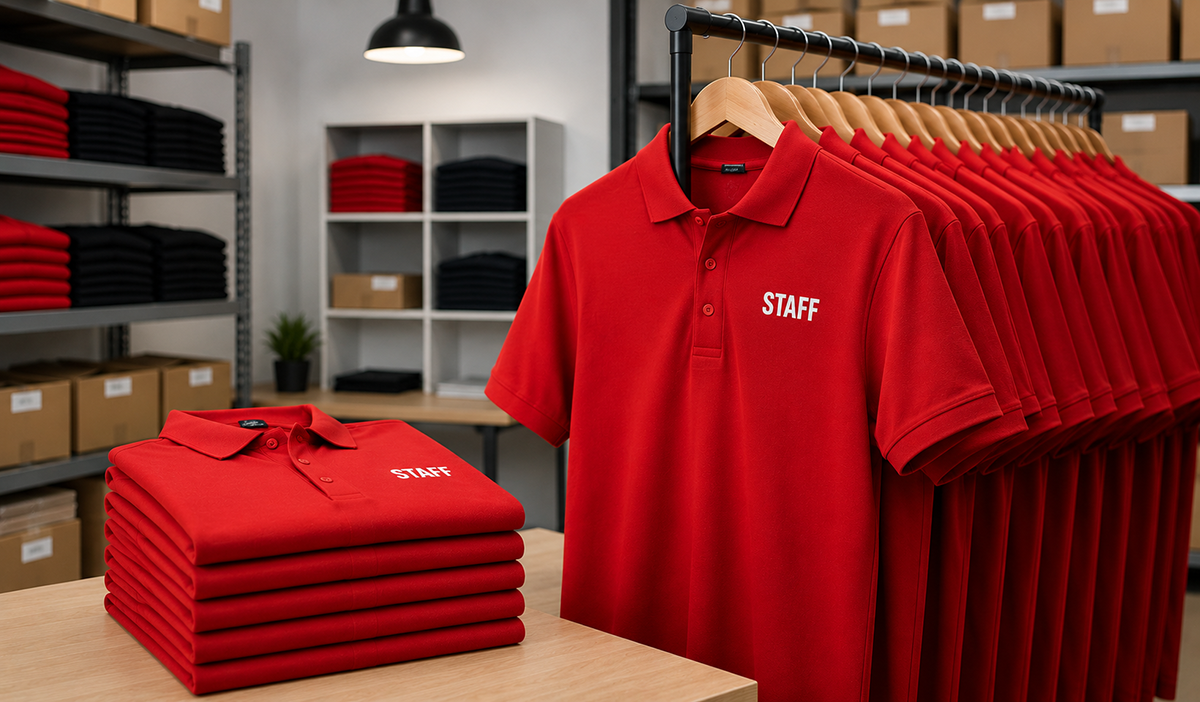
Staff Uniform Management: Tips for Streamlining Your Workplace Apparel
For any business that relies on uniformed staff, managing those uniforms is more work than most people anticipate. Ordering the right sizes, tracking who has what, replacing worn-out pieces, onboarding new hires, and keeping everything looking consistent across locations — it adds up fast. Without a solid system in place, staff uniform management can become a time-consuming, expensive headache.
The good news is that with the right processes and the right supplier, managing your company staff uniforms does not have to be complicated. This guide covers everything from what staff uniform management actually involves to practical tips for streamlining the entire process — whether you have a team of 10 or a workforce of thousands.
What Is Staff Uniform Management and Why Is It Important?
Staff uniform management refers to the full lifecycle of your company’s branded apparel — from initial design and ordering, to distribution, tracking, replacement, and eventual retirement of worn items. It encompasses:
- Determining what uniforms each role requires
- Sourcing and ordering from reliable staff uniform suppliers
- Tracking inventory and individual employee allocations
- Managing sizing and fit for a diverse workforce
- Handling replacements, returns, and offboarding
- Maintaining consistency in appearance across teams and locations
Done well, uniform management ensures your team always looks sharp and on-brand. Done poorly, it results in employees showing up in mismatched, faded, or ill-fitting apparel — which directly impacts your brand image and employee morale.
The Challenges of Managing Employee Uniforms
If you have tried to manage uniforms for a growing team, you already know the pain points. Some of the most common challenges businesses face include:
Tracking Who Has What
Without a system, it is easy to lose track of how many uniforms each employee has, which sizes are in stock, and who needs replacements. This becomes especially complicated with high turnover roles.
Onboarding New Employees
Every new hire needs to be outfitted quickly. Delays in getting new employees into proper uniforms can affect their confidence and their ability to represent your brand from day one.
Managing a Diverse Workforce
A team with varied body types, different roles, and sometimes different climate conditions requires a broader range of sizes and styles. Men’s and women’s custom business uniforms often need to be ordered separately to ensure proper fit.
Replacement and Wear
Uniforms wear out. Embroidery fades, fabric thins, and shirts get stained. A good management system anticipates replacement cycles so you are not caught off guard.
Scaling Across Multiple Locations
For businesses with multiple sites or departments, ensuring consistent uniform standards across the board requires coordination, clear policies, and reliable suppliers.
Best Practices for Managing Employee Uniforms
Here are the strategies that make the biggest difference in keeping your uniform program running smoothly:
1. Establish a Clear Uniform Policy
Before anything else, document exactly what your uniform standards are. Which roles wear what? What is the dress code for customer-facing staff versus back-of-house? What are the rules around modifications or personal accessories? A written policy gives employees clear expectations and gives managers a consistent standard to enforce.
2. Create an Inventory Tracking System
Even a simple spreadsheet can dramatically improve your ability to manage uniforms. Track the following:
- Employee name and role
- Sizes and quantities issued
- Date of issue
- Replacement history
- Current stock levels by size
For larger organizations, dedicated uniform management software or an integrated HR tool can automate much of this tracking. Some custom staff uniform suppliers also offer online portals where managers can place orders, track inventory, and manage employee allocations in one place.
3. Set Up a Replacement Schedule
Rather than waiting for uniforms to fall apart, build a proactive replacement cycle into your program. Most work shirts and polos have a useful life of roughly one to two years depending on how often they are worn and how they are cared for. Scheduling annual or bi-annual uniform refreshes keeps your team looking sharp and eliminates the scramble of emergency replacements.
4. Simplify the Ordering Process
One of the biggest time sinks in uniform management is the ordering process itself — gathering size information, compiling orders, coordinating with suppliers, and managing approvals. Streamline this by:
- Partnering with a single reliable supplier for all uniform needs
- Keeping a standing order template that can be updated and resubmitted
- Designating one person per location as the uniform coordinator
- Using online ordering portals when your supplier offers them
5. Plan for Onboarding and Offboarding
Build uniform allocation into your onboarding checklist so new hires receive their apparel on day one. On the offboarding side, have a clear process for collecting uniforms when employees leave — especially if the shirts include embroidery or represent a significant per-unit cost.
6. Order in Bulk to Control Costs
The unit cost of custom staff uniforms drops significantly with volume. Where possible, consolidate orders across departments or locations. Ordering extra inventory in common sizes (typically medium through extra large) gives you a buffer for new hires and replacements without requiring a new order every time.
How to Keep Track of Uniforms Across a Large Workforce
For businesses managing uniforms across a large team, a few additional strategies make a significant difference:
- Barcoding or labeling: Some companies use simple iron-on or sewn-in labels with employee identifiers to track individual items.
- Uniform portals: Some suppliers offer employer-managed online stores where employees can log in, select their sizes, and place orders directly — reducing the administrative burden on managers.
- Regular audits: A quarterly or annual check-in where employees confirm their current uniform inventory helps catch gaps before they become visible problems.
- Digital HR integration: If your HR system tracks employee roles and start dates, connecting that to your uniform ordering process eliminates duplication of effort.
What Tools or Systems Help Improve Staff Uniform Management?
Technology can do a lot of the heavy lifting here. Options range from simple to sophisticated:
- Spreadsheets (Google Sheets or Excel): Good for small to mid-sized teams. Low cost, easy to share, and flexible.
- Inventory management software: Tools like Sortly or similar platforms can track physical inventory with photos, barcodes, and location data.
- Supplier portals: Many professional uniform for staff suppliers offer account management portals that handle ordering, tracking, and invoicing in one place. This is often the most streamlined option for growing businesses.
- HR software integration: Platforms like BambooHR, Gusto, or Workday can be configured to trigger uniform orders as part of the onboarding workflow.
Choosing the Right Staff Uniform Supplier
Your supplier is the backbone of your entire uniform program. A good partner makes management easier; a bad one creates constant problems. When evaluating staff uniform suppliers, look for:
- Consistent quality across large orders
- A wide range of styles, sizes, and customization options
- Reliable turnaround times
- Dedicated account support
- Competitive bulk pricing
- Online ordering and account management tools
Printit4Less has helped businesses across industries build and manage their uniform programs from the ground up. From custom staff uniforms for small teams to large-scale apparel programs, we make the process straightforward and cost-effective.
Final Thoughts
Effective staff uniform management is not glamorous, but it matters. When your team looks consistent, professional, and well-outfitted, it reflects directly on your brand and creates a better experience for both employees and customers. The key is building simple, repeatable systems — and working with a supplier you can count on.
Ready to get started? Get a Quote Today today and let Printit4Less bring your brand to life.
Tags: company staff uniform, custom staff uniforms, staff uniform, staff uniform management, staff uniform suppliers, uniform for staff, workplace apparelCategorised in: Blog
This post was written by TshirtByDesign